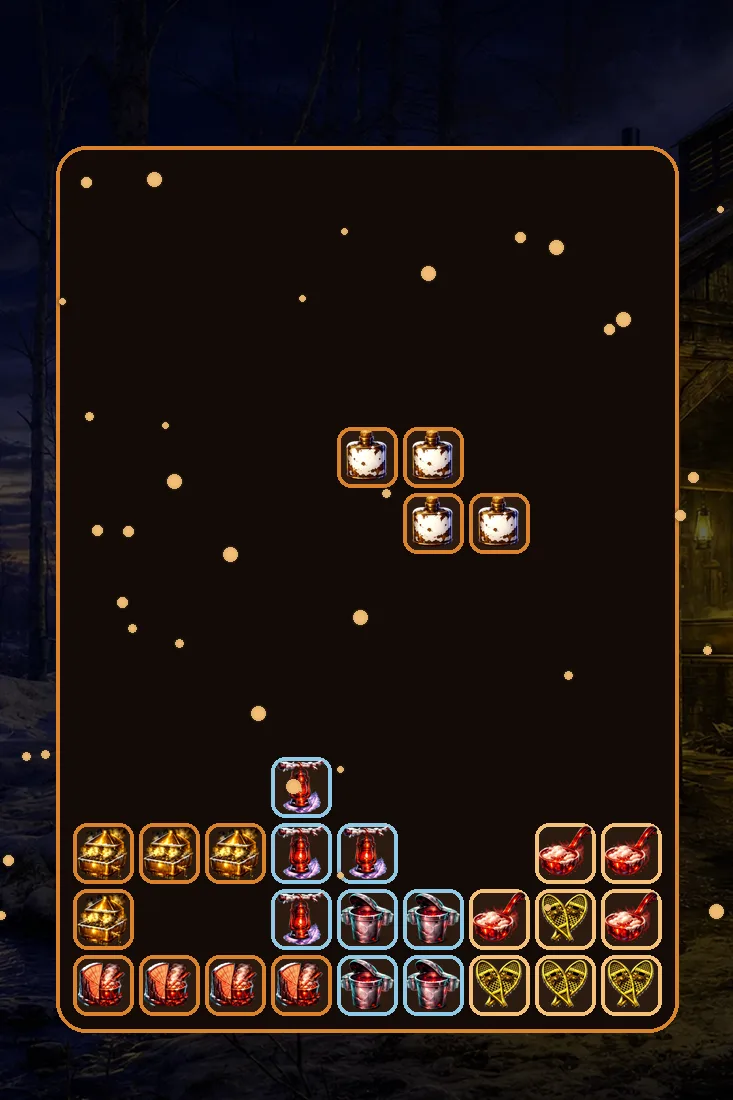
Sugaring Ladder follows the season the way the hollow lives it. You start with an iron spile, the little spout driven into a maple. Two spiles make a twine tag, two tags a sap pail, and from there the chickadee that perches on the rim, the shoulder yoke for hauling, the glowing flask of sap, split cordwood, the fire poker, the firebox ember, the skimming ladle, the steam whistle, the draw-off pan and finally the brass sugarmaker’s seal.
Every push moves every tile, and two identical neighbours that collide fuse into the next step with a soft pop. Merges score points, and the value doubles with each step up the ladder. After every move a new tile lands in an empty square, usually a spile and sometimes a twine tag, so space runs short as the round goes on. When no push can change the board, the round is over.
How to play Sugaring Ladder
- Press Play on the start screen, or switch on the roomier 5x5 board first if you want more breathing space.
- Swipe across the board, press the arrow keys or use W, A, S and D to push every tile one way.
- When two matching tiles collide they merge into the next step of the ladder and add points to your total.
- Glance at the ladder strip under the board; each step glows the first time you reach it in a round.
- Keep pushing until the board locks completely, then see whether you beat your best score.
Sugaring Ladder controls
Getting better at Sugaring Ladder
- Choose one corner for your highest tile and guard it like the warmest seat by the evaporator.
- Lean on two directions most of the time so your biggest tiles stay lined up along one wall.
- Before each push, picture where the next spile might land and whether it could wedge into your chain.
- Keep the Undo for a real disaster, such as a push that drags your top tile out into the open.
- Try the 5x5 board on a slow evening; the extra room is the easiest way to see the upper steps.
Why the season makes a better ladder than numbers
A plain number doubling is neat, but it does not tell a story. We wanted each merge to feel like a day of the sugaring season passing: tapping the trees, hanging the pails, hauling sap on a yoke, splitting wood, feeding the fire and finally drawing off syrup dark enough to seal.
The ladder strip beneath the board keeps that story in view. All thirteen steps sit there in a row, dim until you reach them. Lighting a new one is a small celebration even in a round that ends early, and seeing the steam whistle still dark at the end of a good game is often the reason for one more try.
One Undo, spent like the last stick of dry wood
Every round comes with exactly one Undo. More made the board toothless; none made one slip feel harsh. One is enough to rescue a genuine blunder while still asking you to think before you swipe.
Our advice is to spend it on structure, not tidiness. If a push pulls your best tile out of its corner, or lets a fresh spile slip into the middle of your carefully built row, that is worth undoing. A slightly messy edge usually is not, because a couple of sensible pushes will sort it out. Take a breath before you tap it; often the panic fades and a way out appears.
Questions about Sugaring Ladder
A message tells you the first syrup is drawn and sealed, the final step on the ladder strip lights up, and you can keep playing the same board to push your score even higher.
It makes things roomier. With twenty-five squares instead of sixteen, the board fills more slowly, rounds last longer and the upper steps of the ladder come within reach more often.
From the late merges. Each step is worth double the one below it, so joining two draw-off pans scores far more than a whole evening of joining spiles.