Every game here rewards skill over luck, which means every game can be practised. These are the habits we see in our strongest players and how to build them on a short break.
Patience is the first tool in the shed
The habit we notice most in strong players is that they pause before they act. In Sugaring Ladder, half a second spent looking at where the next spile could land saves boards. In Frostpane Slider, a minute studying the shuffle before the first move can halve your move count. In Kitchen Party Pairs, a calm moment before the second flip is worth more than any quick guess.
Even the fast games reward this. In Snowshoe Scramble, players who panic hold the button too long or waste their mid-air hop. The ones who go furthest seem almost relaxed, watching the trail ahead and pressing with purpose. Speed in these games is mostly the result of calm decisions arriving early, not frantic decisions arriving late.
Cordwood Drop makes the point clearest of all. At low levels there is plenty of time to think, and players who use it build clean, flat stacks. When the pace rises, those same players are calmer because their stack gives them options. Good habits made slowly become good reflexes later, which is the oldest lesson in any woodshed.
Build a frame before you chase points
Several of the hollow’s games reward structure. In Sugaring Ladder, that structure is a corner: one wall where your biggest tiles live, growing outward in a tidy chain. In Cordwood Drop, it is a flat stack with one open column for the long piece. In Frostpane Slider, it is the top row and the left column, solved first and left alone.
Boiling Pan Pop has its own version. Clearing the sides early keeps the walls free for bank shots, and those angles become your main tool once the middle grows crowded. Players who simply fire at the nearest match tend to run out of room; players who shape the ceiling a little get access to the big cluster drops that clear whole sections.
Structure feels slow at first, because it asks you to make moves that do not score straight away. Stick with it. A round or two later, you will notice that you are getting further more reliably, and that the high moments, a new ladder step, four lines at once, a falling cluster, keep turning up instead of arriving by accident.
Train the eye to read the board
Memory and picture puzzles reward clear seeing. In Kitchen Party Pairs, give each card a short label as you turn it, a name and a position, and you will be amazed how much more you keep. Animals are easy to tell apart; the sugar bush keepsakes on the larger tables need a little more attention, so say them aloud if it helps.
In Frostpane Slider, learn to recognize tiles by their scraps of the scene rather than by numbers. A slice of copper pan, the edge of a lamp, a strip of violet sky: these become familiar faster than you would think. Numbers are there whenever you want them, but the picture itself is the better guide once your eyes have adjusted to it.
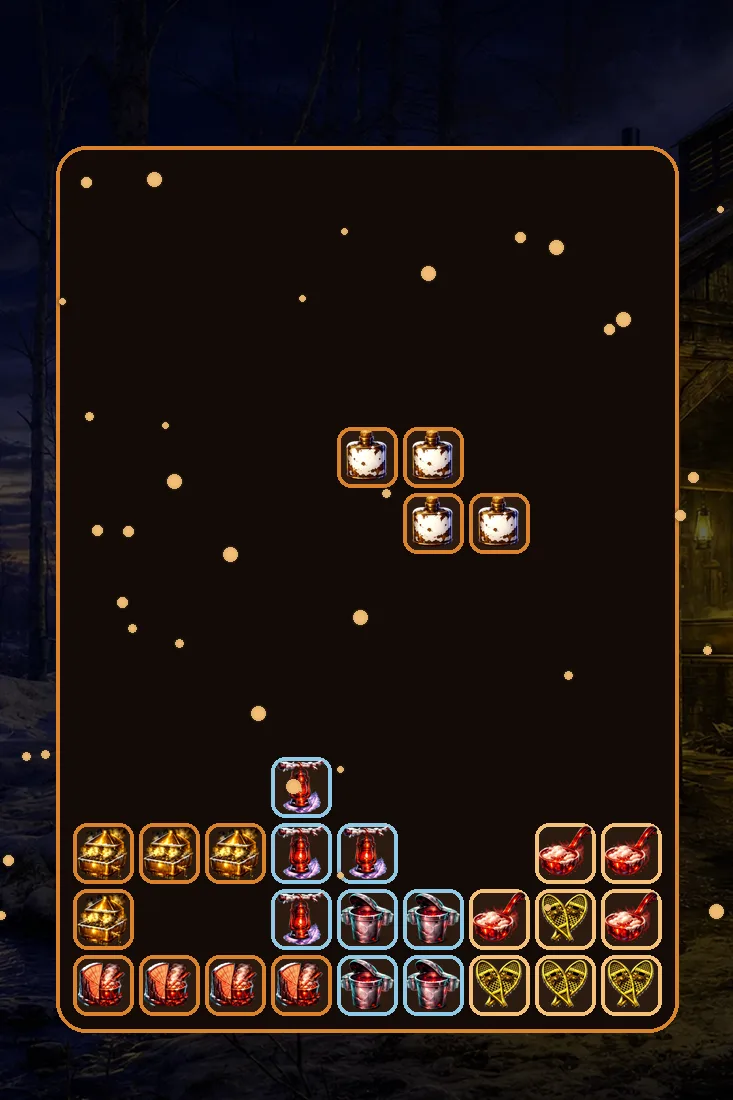
Cordwood Drop benefits too. Each shape type wears its own picture, so after a while you stop seeing outlines and start seeing snowshoes, pails and lamps. That shortcut frees up attention for the next queue and the hold tray, which is where the real planning happens when the woodshed starts to fill.
Use the helpers without guilt
Every game in the hollow comes with a small helper, and they are there to be used. Sugaring Ladder gives you one Undo per round; spend it on a broken corner, not an untidy edge. Cordwood Drop gives you a ghost outline, a next queue and a hold tray. Frostpane Slider gives you Numbers and Peek, neither of which affects your stars.
Learning when to reach for a helper is a skill in itself. The hold tray is most valuable when it holds a piece you know you will need, typically the long straight shape. Peek is most valuable early in a picture, before you have learned its tiles. The Undo is most valuable when you have paused, breathed and still cannot see a way out.
There is no shame in any of them. We designed the helpers so the games feel fair rather than punishing, and so newcomers can see the satisfying parts quickly. Once you know a game well, you may find yourself using them less and less, which is a nice quiet measure of how far you have come.
Short sessions, little and often
The quickest way to improve is not long sessions but frequent short ones. Five minutes of Snowshoe Scramble every day trains your timing better than an hour once a week, because your hands remember the rhythm between sessions. The same is true of bank shots in Boiling Pan Pop and the row-by-row method in Frostpane Slider.
Short sessions also keep the games fun. Frustration builds over long stretches, and frustrated players make worse decisions. If a run goes badly, take a break, pour a hot drink, and come back with fresh eyes. Many of our own best scores arrived on the first attempt of a new day rather than the twentieth attempt of a long night.
Finally, keep an eye on your own progress. Your best scores and stars stay saved in the browser, so it is easy to see how you are improving across days and weeks. Whether you play on a winter commute or in a cabin with no hurry at all, a few minutes in the hollow at a time adds up surprisingly quickly.